Sunday, November 18, 2007


Iraq and even Iran aren’t enough? Well, let’s invade Pakistan

Michael O’Hanlon continues to prove that he and Brookings aren’t anything close to liberal, as O’Hanlon teams with Fred Kagan to call for military action to “stabilize” Pakistan. Among the options they support is, though they say it much more politely, U.S. troops moving in to back up a military coup. I would guess they’re scrolling through the ranks of Pakistani generals as we speak to find the Punjabi Augusto Pinochet.

Just when you think neocons and their “fellow travelers” (yes, that’s you, O’Hanlon; can’t Brookings can his ass?) can’t get any more nutbar, they pull some new surprise rabbit out of their collective asses.


There's more: "Iraq and even Iran aren’t enough? Well, let’s invade Pakistan" >>

Saturday, August 25, 2007


Cry me a river, Michael O’Hanlon

I won’t eat up too much space here on his , puerile response to critics of his and Ken Pollack’s original op-ed saying everything is hunky-dory in Iraq.

I will quote one comment, though:

Unfortunately, much of the blogosphere and other media outlets have emphasized the wrong question, challenging the integrity of anyone who dares to express politically incorrect views about Iraq. (My emphasis)

His views aren’t politically correct to the Bush Administration that he and Ken Pollack try to give intellectual props to, every chance they get.

And, this bullshit that somehow, after hunkering down in the Green Zone in Baghdad for a week, he and Pollack are somehow “daring,” is ludicrous.

I’ve said more than once that Brookings is NOT a liberal think tank. It could prove otherwise by canning people like O’Hanlon.


There's more: "Cry me a river, Michael O’Hanlon" >>

Tuesday, August 21, 2007


Perusing the updated Brookings report, 'Iraq Index'

The Brookings institute released their updated Iraq Index (.pdf alert) yesterday, and there is some data contained therein that puts the lie to the “Surge is working” meme.

For starters, violence isn’t really down, it has just relocated. While attacks in Ramadi and Anbar dropped from an average of 25 per day in 2006 to about 4 per day since the start of the troop buildup; violence is up sharply in Diyala. In 2006, Diyala ranked eighth among all provinces, but in 2007, the province ranks as the third deadliest, and over the last five months, attacks against American forces are up 70%.

Furthermore, as the chart below shows, it is a bit of statistical gymnastics to claim that deaths among American troops are down over the summer months, when the numbers do not lie…while the number of American fatalities is down slightly from the spring and the initial increase in troop strength; when compared to previous summers, the numbers are very grim, and show a sharp increase.
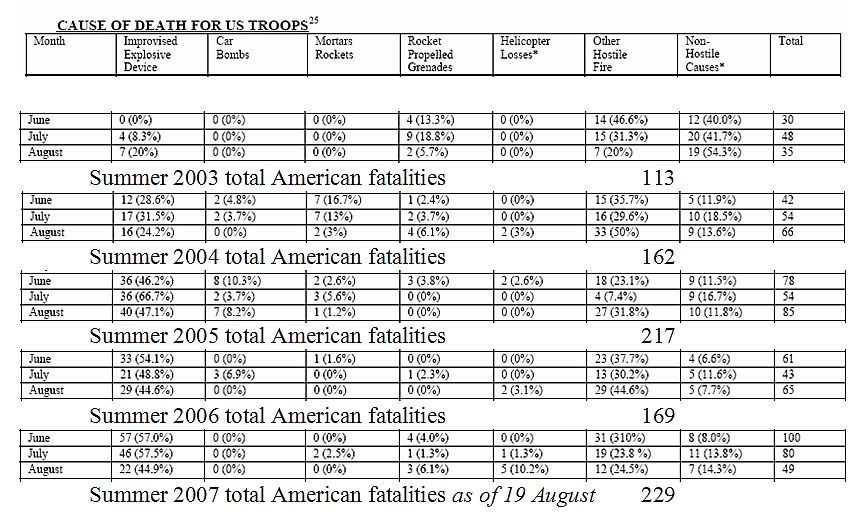
(The full month-by-month chart is available on page 18 of Iraq Index)

Meanwhile, in spite of the fact that the solution has to be at least 80% political, there has been no progress on the political benchmarks. The draft of an Oil Sharing Law was passed in February, but there has been no progress beyond that, and enough Sunni cabinet members have now withdrawn from the government that a quorum is no longer possible.

There has been no progress on the implication of new election laws, and the de-Baathification process has not advanced. There has been no progress toward national reconciliation. There has been no progress made toward bringing Shi’ite militias under control, and the concerns of Sunni lawmakers have not been given due consideration, which has precipitated the withdrawal of Sunni lawmakers from the cabinet.

All in all, there is simply not a lot of positive information to report, and what there is is offset by negative developments elsewhere.


There's more: "Perusing the updated Brookings report, 'Iraq Index'" >>

Saturday, May 19, 2007


A hypothetical question about think tanks and this blog’s home page

(And, I hope this post isn’t considered wasting bandwidth, because the hypothetical question is fairly serious.)

Can Brookings really be considered a “liberal” think tank?

Given the amount it’s moved to the center in the past 5-7 years, my vote is a definite “no.”

What’s yours?


There's more: "A hypothetical question about think tanks and this blog’s home page" >>