The draft agreement sets 2011 as the date by which all remaining U.S. troops will leave Iraq, according to Iraqi Deputy Foreign Minister Mohammed al-Haj Humood and other people familiar with the matter.
Teams of American and Iraqi negotiators spent months haggling over the deal, which represents a remarkable turnaround from just a few months ago, when talk of timetables and deadlines was routinely dismissed by the Bush administration and other Republicans in Washington.
Senior officials in Washington said the talks have concluded. The deal will be presented to the Bush administration and the government of Iraqi Prime Minister Nouri al-Maliki for formal approval or rejection.
"The talking is done," one U.S. official said late Wednesday night. "Now the decision makers choose whether to give it a thumbs up or a thumbs down."
The precise terms of the agreement weren't clear Wednesday night, and the deal's final status likely will remain unsettled for at least a few more weeks.
Gordon Johndroe, a spokesman for the National Security Council, cautioned that the deal was not yet complete. "Discussions are ongoing with the Iraqis to finalize a bilateral agreement," he said. "We are working to complete the agreement, but it is not final yet."
I hope so. Getting out is the best worst outcome, since we can't unring the bell. Be can't uninvade the country, unbomb the cities, resurect the dead, undo the ethnic cleansing, restore the limbs of the wounded...you get my drift - as we can't undo any of that stuff, getting out and letting Iraq engage in self determination seems reasonable to me. But then, I'm not a wingnut chickenhawk.
The deal is virtually guaranteed acceptance by the United States, but in Iraq it is a different story. It has to go through several layers of the Iraqi government, and several members of the cabinet have objected to elements of the agreement, and it also has to gain the approval of the Parliament, and Parliament is on vacation until next month.
I hope it is accepted and implemented, but I am not breaking out the bubbly just yet. I know all too well how tenuous such agreements are, and there is a lot of opportunity for things to go wrong, and there are people with a vested interest in trying to make sure that is the case.
The agreement removes immunity for mercenaries, but I wish it went further. If both sides are serious about ending this thing, the mercenaries need to start leaving within 24 hours of the deal being inked. Companies like Blackwater will cease to make money of the US withdraws, so if the US is serious about leaving, the mercenaries have to all be gone by March, every last one of them, with no exceptions for the State Department.
But on a cheerier note, its a godsend to Barack Obama. McCain has spent the last two weeks talking about "legislating defeat" and all that nonsense; and right before the Democratic convention, negotiators hammer out a deal that is in keeping with his vision for the region, and not McCain's.
And hey! If the same guy who started the war is the guy who accepts the end is nigh and signs the aggreement to end it. In addition it certainly cuts the legs from under the dolschtosselegende the right has ben practicing for several years.
No, it ain't over yet, but this agreement can not be seen as anything but a step in the right direction.
In addition, the reliance on armed security contractors has raised legal, ethical and political questions about the use of mercenaries and private armies - which by their very definition have an interest in continuing hostilities rather than working to bring them to an end - on the 21st century battlefield.
The report by the Congressional Budget Office found that between 2003 and 2007, the government awarded contracts in the Iraqi theater of operations totaling $85 billion dollars, or 20% of expenditures. By years end that total is on pace to exceed $100 Billion.
The CBO report released earlier this week provides rock-solid data for critics of the privatization of warfare, and for the first time it affixes a pricetag to mercenary expenditures.
The number of contractors operating in Iraq - over 180,000 - exceeds the number of American service personnel by tens of thousands and essentially amounts to a second, private, profit-driven army that outnumbers the real Army and faces little or no accountability. Instead, the actions of those mercenary forces are largely hidden from public view. Their roles and missions are unknown and even their casualties are concealed and glossed over. Through the use of private mercenary armies to supply meals and materiel, work as translators and drivers, construction workers, etc the DoD has been able to run a shell game and keep the numbers of military personnel artificially deflated and keeps discussion of conscription out of the public discourse.
The reliance on mercenaries to conduct the war has also raised the specter of political favoritism in the awarding of no-bid contracts. From the earliest days of the war, the administration was determined to keep actual troop levels down and one way to do that was by outsourcing operations to private companies - companies like Kellogg, Brown & Root, a division of Halliburton - the company that was run by Dick Cheney before he was vice president – and which almost immediately became the largest defense contractor operating in Iraq, currently employing at least 40,000 people in the conflict zone.
“This is unprecedented,” he added. “It was considered an all-out imperative by the administration to keep troop levels low, particularly in the beginning of the war, and one way that was done was to shift money and manpower to contractors. But that has exposed the military to greater risks from contractor waste and abuse.”
Dina L. Rasor, an author and independent expert on contracting fraud, said she believed that the $100 billion cost estimate from the Congressional Budget Office might be low, since there were virtually no reliable audits of or controls on spending during the first years of the war. “It is a shocking number, but I still don’t think it is the full cost,” Ms. Rasor said. “I don’t think there have been any credible cost numbers for the Iraq war. There was so much money spent at the beginning of the war, and nobody knows where it went.”
One of the biggest problems with the Iraq misadventure was not only that so much work was outsourced, but in addition, no thought went into the execution or into strategic planning. There was no rhyme nor reason, no protocols to divide the tasks at hand into military and mercenary functions, nor to determine what tasks could be privatized without harming the military effort.
“These new numbers point to the overall question — when do you cross the line in terms of turning over too much of the public mission of defense to private firms,” said Peter Singer, a contracting specialist at the Brookings Institute. “There are some things that are appropriate for private companies to do, but others things that are not. But we don’t seem to have had a strategy for determining which was appropriate and which wasn’t. We have just handed over functions to contractors in a very haphazard way.”
For several years now I have been screaming that we need a reprise of the Truman Committee, empowered to prosecute and imprison, but I have, for the most part been that weird, wonky chick who reads the white papers and thinks too much. Well, finally I have some distinguished company - Senator Byron Dorgan, Democrat of North Dakota, said recently that outsourcing the war had raised so many unanswered questions that he is pushing for the creation of an oversight committee to review and audit contracts awarded to private companies operating in the war zone.
“The Truman Committee held 60 hearings on waste, fraud and abuse,” Mr. Dorgan said. “It’s unfathomable to me that we don’t have a bipartisan investigative committee on contracting in Iraq.”
The dramatic increase in oil prices has positioned Iraq, which sits atop the third largest oil reserve in the world, to begin to bear some of the burden of reconstruction of that war-torn country, decimated by more than two decades of war and sanctions.
In a GAO report released yesterday, the government watchdog was deliberate in avoiding assignation of who-should-pay-for-what and thus the politics of the matter. Instead, they did what they do best and stuck to facts and figures - but in so doing, the report leaves little doubt that Iraq can afford to pony over a bit more dough for its own reconstruction. Iraq took in just under $33 Billion in oil revenues in the first six months of 2008, and is on pace to rake in between $67 and $79 Billion this year, meaning Iraq could see a budget surplus of between $38.2 billion and $50.3 billion this year alone. The GAO estimates that this years oil revenues will be double the average annual oil revenues that were realized from 2005 through 2007. The GAO based their projections for the second half of the year on actual sales through the first half, and assumed an average export price from $96.88 to $125.29 per barrel and oil export volumes of 1.89 to 2.01 million barrels per day.
As oil prices settle down at around $125 per barrel, after exceeding $140 just a few weeks ago, Iraq could post a budget surplus of between $33 billion and $50 billion this year. This windfall comes in spite of the fact that Iraq has yet to approach pre-invasion oil-production levels.
Between 2005 and 2007, the government of Iraq spent approximately $67 billion on government operations and investments in the greater society. About 90% was spent on operations, and 10% was invested in structures and durable goods. A mere one percent was spent on maintaining the country. Instead the United States has been footing that bill. Buildings, infrastructure for the delivery of water and electricity, and weapons for the countries police and security forces.
Even as total expenditures grew from 2005 through 2007, the country was unable to spend all of the budgeted funds. For example - last year, 2007, Iraq spent 80% of ths $28 billion operating budget and 28% of its investment budget. GAO estimates that in 2008, Iraq will spend less than $40 billion of its nearly $50 billion budget.
At the end of 2007, the Iraqi government had financial deposits of $29.4 billion, held in the Development Fund for Iraq and other deposits made in the name of the central government in the Central Bank of Iraq and Iraq’s commercial banks. This balance is due to budget surpluses of about $29 billion between 2005 and 2007.
And then there are the American numbers.
Since FY 2003, when the U.S. appropriated approximately $48 billion for stabilization and reconstruction efforts of post-invasion Iraq. As of June 2008, about $42 billion of that amount had been obligated. Of that $42 billion, the United States has spent more than $23 billion on security and critical infrastructure, such as water, electricity and oil. Compare that expenditure with the $3.9 billion spent in these sectors by Iraq between 2005 and April of this year.
Now there are multiple reasons why the Iraqi government has been unable to invest more of its money on capital improvements, and some of those shortcomings were created by the United States and our coalition allies when civil servants were summarily fired by the Coalition Provisional Authority (CPA) and barred from public service for being members of the Bath Party (a requirement for government employment) under the Saddam Hussein regime. When the people who know how to work the levers are not allowed to touch the machine, it doesn't work.
De-bathification was a factor in several areas of shortfall, from operations to procurement and budgeting. De-bathification coupled with sectarian violence and the "brain drain" that resulted from the middle class fleeing the country made government operations in Iraq ineffectual at best. These factors converged and conspired to make it necessary for the United States to fund activities of key ministries to even get the country on a footing where it could begin to execute it's own budget priorities.
Now let me be clear that it is not my intent to debate who should be paying for the reconstruction. If I had my druthers we would be able to unring the bell, unselect George Bush, uninvade Iraq and unhang Saddam Hussein. But as none of that is possible, we have to look at the situation at hand and make realistic assessments. And reality dictates that the United States can not keep up the level of spending we have been engaged in in Iraq. Certainly not with all the problems we face at home.
Iraqi and American officials have admitted that in spite of a statistical drop in violence during the Surge™, the state slipped further over the brink into lawlessness over the last year. Corruption and theft have never really been out of favor in Iraq, but occupied Iraq has become nothing short of a kleptocracy. According to an independent analysis, Iraq is the third most corrupt nation in the world - of 180 countries surveyed, only Somalia and Myanmar were more corrupt than Iraq. The scope of the theft is staggering. It is estimated that as much as 1/3 of what American taxpayers are spending on reconstruction contracts ends up stolen, with a healthy cut going to militias. The top anticorruption official in Iraq estimated that $18 Billion had been filched since 2004.
That official resigned his position and fled the country a few weeks ago, after 31 of his agencies employees were hunted down and executed over the past three years.
[Keep reading...] All this stealing and pilfering undermines the ability of the nation to provide essential services, yet providing the basics is integral to sustaining the recent perceived advances in security. It also facilitates a distrust of government and throws up roadblocks to reconciliation as groups with an established foothold in the Shiite dominated government resist reforms that would rein in the systemic corruption.
The average Iraqi, for the most part, finds the thieving to be a major source of embarrassment. They feel like the corruption and thievery affects them on an emotional and moral level, and point to what the Q'uran says about theft - Allah is against it. "God does not love the corrupters," is a theme that runs throughout the Q'uran. The Iraqis who were horrified at the looting in the wake of the invasion and toppling of Saddam Hussein are doubly ashamed of the libertarian free-for-all their country has turned into because the tentacles of corruption reach into every nook and cranny of the society.
If you have children in school, you have to buy their textbooks from, a profiteer at three times the price charged by the ministry of education. If you want to wash your car, chances are the carwash is stealing the water from the degraded infrastructure that supplies water to homes and citizens. If you have a loved one with cancer, their pain medications are only available on the black market and are devastatingly overpriced. If you need a job, pay a $500 bribe and become a policeman.
And it has degraded so far that corruption is no longer a means to wealth, it is a way of life. It has created an endless spiral of dishonest dealings, and everyone feels the taint.
WASHINGTON, Nov. 24 — With American military successes outpacing political gains in Iraq, the Bush administration has lowered its expectation of quickly achieving major steps toward unifying the country, including passage of a long-stymied plan to share oil revenues and holding regional elections.
Instead, administration officials say they are focusing their immediate efforts on several more limited but achievable goals in the hope of convincing Iraqis, foreign governments and Americans that progress is being made toward the political breakthroughs that the military campaign of the past 10 months was supposed to promote.
Now, the focus has shifted to smaller, short-term goals - like authorizing a budget for the nation. (But the Iraqis are already in the process of doing that anyway.)
And of course, the Bush maladministration is all hot and bothered to get the U.N. mandate that authorizes the presence of the American occupiers renewed. (They do this routinely because it's a puppet government that would not exist for more than thirty days if the Americans weren't propping them up.)
And de-de-baathification, so members of Saddam Hussein's Baath party can reenter government service. (That's merely pro forma - former Baathists have been rehired on the q.t. for some time, because they are the ones who actually know how to, you know, do the jobs.) [Keep reading...I'm not even warmed up yet...] The administration insists that they have not given up on their larger goals, averring that they will be met *eventually.* But damnit, they have to figure out a way to make lemonade, and do it pronto.
They sold the AEI's Surge™ scheme by packaging it as a necessity, needed to give the political process "breathing space" to achieve reconciliation. Tours were extended, leaving soldiers in combat for 15 months with only 12 months dwell-time. They sacrificed American lives like they meant nothing. And the Iraqi parliament went on vacation the entire month of August. Tony "Karma's a Bitch" Snow excused the fecklessness of the Iraqi politicians with a blasé "It's 130 degrees in Baghdad in August," conveniently forgetting that his war-criminal boss sent American fighting forces into that hellhole, and they didn't even get the benefit of operating in an air conditioned Green Zone when it was 130 degrees. But reconciliation didn't happen.
In fact, Maliki and Hashemi snipe at one another like two bleached-blond teenage girls vying for head cheerleader in a one-high-school Texas football town.
Instead of sucking it up and admitting that things didn't work as planned, they are insisting that modest steps such as these - if taken soon - could, maybe, perhaps, if they cross their fingers and say the right magic words in just the right order and cadence, perhaps while hopping on one foot and chanting "I believe" - set the stage for "more progress." You know - like the Surge™ set the stage for the arming of the Sunni thugs who in the past were the insurgents who were killing Americans. (Well, give 'em guns and money and you can rent some temporary loyalty...)
But not to fear! aWol is "applying pressure" on the Iraqi government to produce some sort of political progress. “If we can show progress outside of the security sector alone, that will go a long way to demonstrate that we are in fact on a sustainable path to stability in Iraq,” said one senior official, speaking on condition of anonymity. On Saturday, [U.S. Ambassador to Iraq Ryan] Crocker said the military had created opportunities for progress, and added that there were "indications" that Iraqis wanted to move forward on the local and national levels. But he quickly dialed back the expectations and cautioned against expecting quick results on the core issues.
“We are seeing encouraging signs of movement. This is going to be a long, hard slog,” he said, apparently channeling Rumsfeld, "It is going to be one thing at a time, maybe two things at a time, we hope with increasing momentum,” he said. “It is a long-term process.”
Although violence has ticked downward in recent months, the administration has not touted this development, because if they did, scrutiny would surely follow, and that they certainly don't want.
Furthermore, there are clear signs that any influence Americans have over Iraqi politicians is dwindling. In the absence of religious and ethnic reconciliation, the expectation has been dialed back to "accommodation." An American official, again speaking on condition of anonymity, said “We can’t pass their legislation. We can’t make them like each other. We can’t even make them talk to each other."
Crocker at least realizes that “The political stuff does not lend itself to sending out a couple of battalions to help the Iraqi’s pass legislation.” Still, he insisted that there are some positive signs that Iraqis are interested in making their own headway. For example, he pointed to Provincial governors, who are pressing for a law to define their powers. “We are past the point where it is an American agenda,” the ambassador said. “It is what needs to be done in Iraqi terms.” (In plain English - this is how warlords are made.)
Officials in both Baghdad and Washington are both realistic about the fact that military gains are not enough to overcome the deep divides that separate Iraqi factions. But in both capitals there are leaders who still engage in magical thinking. “We need a grand bargain among all the groups,” said a member of the Iraqi government - speaking - you guessed it - anonymously.
The most disturbing part of the whole thing is the repeated references to "long hard slogs" and the allusions to extended, multi-year commitments of American forces, like it's no big deal. But it is a big deal. Maybe not to these worthless, faithless and feckless jackals who have nothing to lose. But to the rest of us, it sure as hell is.
And if you agree, vote Democratic. Give the congress a Democratic president, and just as importantly the votes to end the obstruction of the Republican wingnuts who have no qualms about obstructing progress at the expense of American lives.
George aWol Bush has made the biggest mess the world has ever seen, and intends to keep the fucking up going apace and leave a mess so dire that the next president won't be able to extract us from.
Don't let him get away with it. Congress holds the pursestrings. Not one dime without strings attached. Not one dime.
The 10th Mountain Division out of Ft. Drum, NY is heading home – and carrying heavy baggage. 52 of their own died fighting in Iraq, and they left two behind, still missing after being abducted last May, their fates unknown. “That was pretty catastrophic for them,” said Major General Michael Oates, 10th Mountain Division commander.
The 10th Mountain Division had their tours extended from 12 to 15 months 10 months in to what was for many a second or third deployment. They were ten months in, and counting down the days until they shipped out for home when the word came down that all Army personnel in Iraq would be extended to 15 months.
Several returning soldiers dropped down to kiss the ground when they returned home, and what they looked forward to enjoying at home differed. Specialist A.J. Mettao employed the word “surreal” to describe his feelings. “I can’t even explain it. The air is so different. You’re not breathing sand. I’m looking forward to living life and just partying.” Another returning soldier, Chief Warrant Officer Harold Bickel wanted nothing more than to see his wife, but he also wants to “go hunting in the woods” and to celebrate New Years Eve in Las Vegas. Asked what she most looks forward to PFC Maria Basulto had an answer ready: “getting out of the Army.” She is certainly no fan of the extended tours that made the Surge™ shell-game possible. “The hardest part was finding out at 10 months that we had to stay. That was messed up.”
When I was growing up, Viet Nam was the looming specter, and everyone I knew had someone who had either just returned, was in-country or had orders to go. Every family had a way of marking time – some simply circled a date on a calendar. In our house it was a safety-pin chain. 365 safety pins would be affixed to the living room drapes, and every night after dinner, we took one off and put it in a cigar box. At one point, when three family members were deployed simultaneously, there were three chains hanging from the drapes. At first, the chains coiled on the floor. But every day, they got shorter. Then one day it no longer touched the floor, and eventually the youngest kid could no longer reach it. The final pin was always removed by the person we were marking time for when they walked in the door. I can not imagine what I would have felt if that chain I lived and died by had been lengthened from 60 to 150. My cousin Gary died in March of 1967 with 97 days left on his tour. 97 safety pins are still, 40 years later, in my aunt Lorraine’s jewelry box. She asked my Mom to send “Gary’s lifeline” to her at the funeral. I can still see my mother, standing on the step-stool and crying as she removed that string of safety pins and, with a shaking hand, drop them into a manila envelope addressed to my Aunt Lorraine when we returned home after the funeral.
That was when it became real. We had been to the funeral, we had viewed his body. Aunt Lorraine had stoically received the tri-corner flag as his casket was lowered into the Kansas earth. We had hugged and cried and clung to one another. But that intact chain of safety pins…watching my mother do something so simple and ordinary and mundane as remove a safety-pin from a curtain was the cathartic moment that opened the floodgates of grief in my tiny little four-year-old heart. My favorite cousin was gone, and he was never coming back.
Families develop coping strategies to get through it. Non-military people don’t realize it, but families serve, too. Everyone always has a vision of what the long-awaited reunion will be like. Some are apprehensive, some are idyllic, some are wistful and prosaic, while others are simply overwhelming. Many soldiers return to meet for the first time children born while they were deployed. Families assembled in the gymnasium at Ft. Drum yesterday were no exception. One young mom whose husband had yet to meet his daughter said her top priority was giving her husband the time and space to get to know his 9-month-old daughter. Another Army wife, who has done this before, and whose children are a bit older, was not circumspect at all. Rather, she was matter-of-fact...”I just know that I’m not taking out the trash ever again. I have a full trash can right now because I knew he was coming home. I didn’t empty the bathroom trash, the bedroom trash – nothing. It’s all waiting for him.”
Relief, humor, grief, apprehension – emotions run the gamut when G.I.’s return home. But there is always somber reflection, too. One Specialist, returning from his second tour was matter-of-fact. “The first time I went over, I was excited and wanted to do my job and make a difference. But that was before I saw how war really works. The only way to stay sane is to shut down emotionally.” He went on to say that he had lost good friends on both tours and that he finds himself “desensitized” and worries about the effect it will have on his three-year-old marriage, and his wife’s complaints that he is “distant” even when they are in the same room. “I’m out in ’09. I can’t do this anymore. I don’t like the person I’ve become.”
Retired Lt. General Ricardo Sanchez took a swipe at the aWol Bush maladministration and their inept, incompetent and inconsistent management of the occupation of Iraq.The United States is “living a nightmare with no end in sight.” He warned.“After more than fours years of fighting, America continues its desperate struggle in Iraq without any concerted effort to devise a strategy that will achieve victory in that war-torn country or in the greater conflict against extremism.” General Sanchez was speaking to a gathering here of military reporters and editors.
The remarks were made during one of the first public speeches Sanchez has given since leaving the Army late last year.He blamed the administration for launching and mismanaging a “catastrophically flawed, unrealistically optimistic war plan”and he denounced the current “surge™” strategy as a “desperate” move that will fail to establish long-term stability.
General Sanchez is the most senior in a string of retired generals to harshly criticize the administration’s conduct of the war. Asked following his remarks why he waited nearly a year after his retirement to outline his views, he responded that that it was not the place of active duty officers to challenge lawful orders from civilian authorities. General Sanchez, who is said to be considering a book, promised further public statements criticizing officials by name.
“There was been a glaring and unfortunate display of incompetent strategic leadership within our national leaders,” he said, adding later in his remarks that civilian officials have been “derelict in their duties” and guilty of a “lust for power.”
The White House had no initial comment.
[keep reading]
Sanchez is speaking out, in the face of the slime machine, even though he knows full well that he has an Abu Ghraib problem that will make him a target of vicious criticisms and accusations that he is trying to shift blame for his own shortcomings to the poor, hapless president.Although Sanchez was cleared of wrongdoing in the Abu Ghraib prisoner abuse scandal by an Army investigation, he became a symbol of an occupation that was botched from the get-go.
Look for accusations that he has an axe to grind, that he is seeking revenge against the president who opted not to nominate him for a fourth star and effectively ended his career, forcing him into retirement.
Taking questions from reporters after his presentation, he included the military command structure, himself included, among those who exercised poor judgment and made tragic mistakes in the invasion and occupation of Iraq.He lamented the failure to insist on a post-war stabilization plan.
Still, the bulk of his criticism was directed at the Bush administration and their failures of leadership.He lambasted them for failures to mobilize the entire U.S. government and not just the military in the reconstruction and stabilization efforts in Iraq.“National leadership continues to believe that victory can be achieved by military power alone,” he said. “Continued manipulations and adjustments to our military strategy will not achieve victory. The best we can do with this flawed approach is stave off defeat.”
He accused the administration of failing to craft any kind of strategy that went beyond military force.“The administration, Congress and the entire inter-agency, especially the State Department, must shoulder responsibility for the catastrophic failure, and the American people must hold them accountable,” General Sanchez said.
In the wake of a Sunday firefight near Nisoor square in Baghdad that left eight civilians dead and fourteen injured, Iraq's Interior Ministry has revoked the license of Blackwater Security Consulting to operate inside Iraq.
Details are doling out slowly, but witness accounts of the incident reported that one side of the gun battle involved westerners driving sport utility vehicles, of the type used by western contractors; al-Iraqiya, the state-owned television network, reported that a western security company was involved, but did not identify which one.
The firefight erupted after a State Department motorcade came under small-arms fire near Nisoor Square, and one of the vehicles was disabled. No State Department officials were injured, but offered no information on Iraqi casualties.
Today, the Iraqi Interior Ministry took concrete steps to rein in one of the mercenary outfits that infests their country. "We have revoked Blackwater's license to operate in Iraq. As of now they are not allowed to operate anywhere in the Republic of Iraq," Interior Ministry spokesman Brig. Gen. Abdul Kareem Khalaf said Monday. "The investigation is ongoing, and all those responsible for Sunday's killing will be referred to Iraqi justice."
Iraqi officials have complained bitterly about shootings by private military contractors, but Iraqi courts lack the authority to bring contractors to trial or hold them accountable. Additionally, they are not subject to UCMJ, so essentially, a contractor is unaccountable to anyone - a contractor can commit a war crime and the stiffest punishment will be getting tossed out of the country, still a free man. The U.S. military has complained that mercenaries will touch off violence, then call them to clean up the mess.
In February the House Committee on Oversight and Government Reform estimated that nearly $4 billion had been paid out to mercenary outfits since the invasion of Iraq in 2003. These costs have forced the delay and cancellation of reconstruction projects.
Stay tuned for further developments. I will be revisiting the issue as details emerge.
By Edger - Cross-posted from OOIBC ........................................................................
By it's nature the Out Of Iraq Bloggers Caucus is, as our tagline describes, a "coalition of the willing", not a top down organization speaking with one voice, but a gathering place for bloggers united in opposition to the Iraq occupation, each with their own motivations, each with their own ideas on how the occupation can be ended.
I want to talk today about my own views, and also about a short conversation I had yesterday about whether and about how the Iraq occupation could be ended - but first I want to provide some background against which to express my own thoughts. I also hope here to encourage other OOIBC members to post their thoughts. I speak only for myself here.
OOIBC is subset of a much larger "coalition of the willing", a microcosm of the tens of millions of people who, expressing, in the words of Keith Olbermann "the collective will of the nearly 70 percent of Americans who reject this War of Lies", in the 2006 midterm elections repudiated the Republican party and I think George W. Bush's foreign policies, and swept the Democratic Party into a Congressional majority on the strength of one single issue, one overwhelming mandate.
A mandate they have since, in my view, grievously insulted the people who gave them the Congressional power they now hold by ignoring.
Few men or women elected in our history-whether executive or legislative, state or national-have been sent into office with a mandate more obvious, nor instructions more clear:
Get us out of Iraq.
Yet after six months of preparation and execution-half a year gathering the strands of public support; translating into action, the collective will of the nearly 70 percent of Americans who reject this War of Lies, the Democrats have managed only this:
The Democratic leadership has surrendered to a president-if not the worst president, then easily the most selfish, in our history-who happily blackmails his own people, and uses his own military personnel as hostages to his asinine demand, that the Democrats "give the troops their money";
The Democratic leadership has agreed to finance the deaths of Americans in a war that has only reduced the security of Americans;
The Democratic leadership has given Mr. Bush all that he wanted, with the only caveat being, not merely meaningless symbolism about benchmarks for the Iraqi government, but optional meaningless symbolism about benchmarks for the Iraqi government.
The Democratic leadership has, in sum, claimed a compromise with the Administration, in which the only things truly compromised, are the trust of the voters, the ethics of the Democrats, and the lives of our brave, and doomed, friends, and family, in Iraq.
Now, a little more than three months later, nothing has changed and it appears that there is no movement by the Democratic controlled Congress toward ending the financing of "the deaths of Americans in a war that has only reduced the security of Americans".
In some comments beginning here replying to a post by Big Tent Democrat at TalkLeft yesterday, Glenn Greenwald made it clear that he now feels there is no possibility of the Democratic leadership ending the occupation of Iraq in the near future, if ever.
I'm not advising Democrats to give up on Iraq. I think they ought to force the President to withdraw.
But I'm not going to lie to my readers to make them feel better. Everything I've seen from Democrats makes me conclude that nothing that anyone does will ever make them stand up to the President with sufficient unity and in sufficient numbers to force him to stop the war.
That's just reality. They can't even restore habeas corpus or defy the President's demand for vast new warrantless surveillance powers. The idea that they are going one day soon wake up and Stop the War is fanciful, no matter how much you wish it were otherwise (and, contrary to your weird praise of Atrios, he has made that point more emphatically and more continuously than anyone I know).
I'm not writing prescriptively, but descriptively. I'm not recommending that Democrats not try to stop the war. I'm not recommending that anyone stop trying. I'm just giving my honest assessment that they are not going to do it.
I earnestly hope that Glenn is wrong on this, but I believe he is not, and I agree with him.
I also have come to believe that the Democratic Leadership has no motivation to end the Iraq occupation. I think that they believe they will retain and perhaps increase their control of Congress next year, and that Democratic presidential frontrunner candidates Barack Obama and Hillary Clinton believe that they can count on winning the presidency without ending the Iraq occupation, almost if not fully on the strength of one message - that they are not Republicans.
I think they are counting on the fear of another four if not eight years of Republican government to provide the votes for them, without having to live up to their implied promises and the expectations of them that three quarters of voters hold. I think that they are not afraid they will pay any political price whatsoever in 2008 for not living up to those implied promises and the expectations.
But I think they are not simply afraid of nothing.
I think that they, like the Republicans, are afraid of one thing.
They are afraid that the US economy cannot and will not continue to dominate the world economy, and will collapse, unless the US is able to dominate the energy resources of the world, and that cannot be done if the US withdraws from Iraq.
The invasion and the occupation of Iraq was not done to deliver 'freedom and democracy' to Iraq. It was done in the hope of ensuring US economic dominance.
Larry Everest writing at ZNet shortly before the last Emergency Supplemental funding the occupation was passed in May (the first one passed by a Democratic controlled Congress after years of supplementals passed by Republicans) described the problem much more succinctly that I am able to:
What the Bush Regime portrays as a noble effort to make the world safe from terrorism and bring democracy to the Middle East is actually a vicious war of empire to deepen the U.S. stranglehold on the Middle East and Central Asia --a war that is part of a broader effort to create an unchallenged and unchallengeable imperialist empire.
This goal is not viewed as capricious or incidental by those in charge--whether Democrats or Republicans--rather it flows from the deepest needs and drives of their system: U.S. hegemony in the Middle East and global dominance is crucial for U.S. capitalism's ongoing functioning and U.S. global power. ... So when Bush says, "Even if you thought it was a mistake to go into Iraq, it would be a far greater mistake to pull out now," he's expressing a fear -- from an imperialist viewpoint - that a U.S. pullout would leave the empire weaker. And he is saying this in opposition to other forces in the U.S. ruling class who, also coming from an imperialist viewpoint, now think it's a big mistake for the U.S. not to withdraw.
This whole dynamic of riding the anti-war vote to power, then voting to fund an ongoing war while claiming to be ending it, reflect the conflicting necessities the Democrats face. As representatives of U.S. imperialism, they are committed to maintaining U.S. global dominance. Yet they fear the U.S. is sliding toward a strategic debacle of epic proportions and may already have lost the war in Iraq.
Glenn Greenwald yesterday was expressing his belief of the reality of the situation with "Everything I've seen from Democrats makes me conclude that nothing that anyone does will ever make them stand up to the President with sufficient unity and in sufficient numbers to force him to stop the war."
I agree with Glenn. They will not end it. They have no reason or motivation to, if they can count on voter support in 2008 without ending it.
The evidence states that Democrats are basically on board with Bush.
This has been obvious for some time. Since the supplemental in the spring at least. The FISA Amendment should have been the clincher for anyone who doubted it.
They are not capitulating to Bush. They are complicit with Bush. They are confident that the electorate will capitulate to them next year out of fear of the republicans. They are playing people. This, in my view, is Democrats using the same fearmongering tactics the Republicans used so successfully for the past few years.
It's very difficult to imagine a political reality developing under which current Democrats (again I refer to leadership and presidential frontrunners) will end the occupation of Iraq.
But it is not at all difficult to imagine how it can happen.
I believe that people would feel energized if they saw and heard enough people leading us in the right direction on Iraq, and that if leading Democrats heard enough people say to them that they will not vote for ANY Democrats next year EXCEPT Democrats who have been vocally, and by their votes on supplementals, calling for total withdrawal from Iraq they would quickly notice.
They are politicians after all, and they are concerned with winning elections.
They would notice if enough people turned the tables on them and used fear to motivate them, instead of voting simply out of fear of republicans.
If Democrats were filled with fear that they would lose Congress and the presidency UNLESS the occupation was ended before the 2008 elections, they would end the occupation of Iraq.
I hope that Glenn Greenwald will use the voice and the reach and the influence he has to encourage people to threaten the Democratic Leadership and presidential hopefuls with loss of support unless they do the job the voters who gave them the Congressional majority they now hold expect of them.
As Keith Olbermann also said in May:
Those who seek the Democratic nomination need to-for their own political futures and, with a thousand times more solemnity and importance, for the individual futures of our troops-denounce this betrayal, vote against it, and, if need be, unseat Majority Leader Reid and Speaker Pelosi if they continue down this path of guilty, fatal acquiescence to the tragically misguided will of a monomaniacal president.
The Brookings institute released their updated Iraq Index(.pdf alert) yesterday, and there is some data contained therein that puts the lie to the “Surge is working” meme.
For starters, violence isn’t really down, it has just relocated.While attacks in Ramadi and Anbar dropped from an average of 25 per day in 2006 to about 4 per day since the start of the troop buildup; violence is up sharply in Diyala. In 2006, Diyala ranked eighth among all provinces, but in 2007, the province ranks as the third deadliest, and over the last five months, attacks against American forces are up 70%.
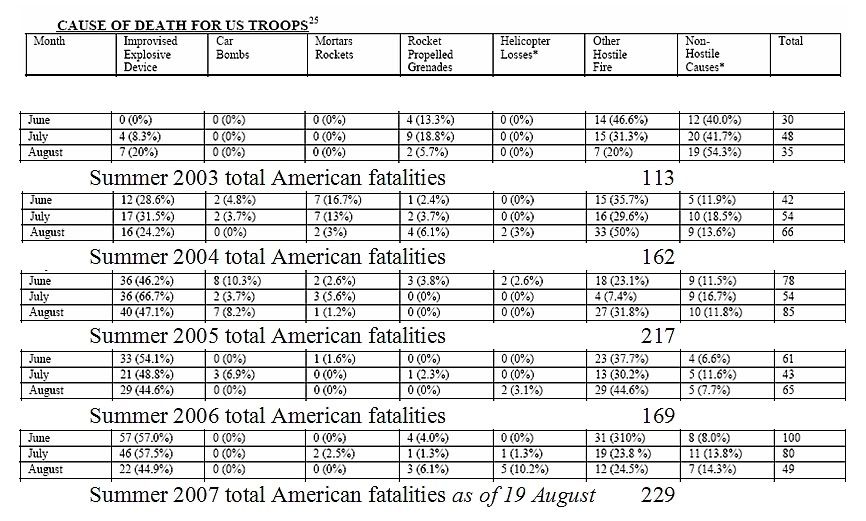
Furthermore, as the chart below shows, it is a bit of statistical gymnastics to claim that deaths among American troops are down over the summer months, when the numbers do not lie…while the number of American fatalities is down slightly from the spring and the initial increase in troop strength; when compared to previous summers, the numbers are very grim, and show a sharp increase.
(The full month-by-month chart is available on page 18 of Iraq Index)
Meanwhile, in spite of the fact that the solution has to be at least 80% political, there has been no progress on the political benchmarks.The draft of an Oil Sharing Law was passed in February, but there has been no progress beyond that, and enough Sunni cabinet members have now withdrawn from the government that a quorum is no longer possible.
There has been no progress on the implication of new election laws, and the de-Baathification process has not advanced.There has been no progress toward national reconciliation.There has been no progress made toward bringing Shi’ite militias under control, and the concerns of Sunni lawmakers have not been given due consideration, which has precipitated the withdrawal of Sunni lawmakers from the cabinet.
All in all, there is simply not a lot of positive information to report, and what there is is offset by negative developments elsewhere.
Accountability. We have to be accountable, and we think our politicians should be too. We do not want a replay of the craven perfidy of the last 12 years that nearly sunk the ship of state. The administrators of this blog have decided, as a group, that working to elect real Democrats to office at all levels of government is the best way to achieve the restoration of oversight and accountability.
But please! Don’t make the mistake of thinking of us as battered wives who keep coming back for more, because that would be totally wrong. Parole Officers would be much more fitting. (Full Mission Statement here.)